Our Training Courses
What Is Hoped To Be Achieved From the Training & Awareness Course
- The provision of support to a suffer by a chosen support group for one hour a day for three months, to reach an agreed goal.
- Providing education and understanding of the illness to both supporters and sufferers through Dysfunction of the Autonomic Nervous System and how this condition can be treated through several sensory methods. i.e. sound, smell, taste and much more
- Work projects are designed to suit sufferer’s capabilities at different stages of their recovery
- Links to existing support agencies – There is no pressure on the sufferer to enlist.
The outline of the plan which provides the necessary tools and support to aid a recovery programme that will at least provide the means of a better quality of life for people suffering from Agoraphobia and other anxiety-based issues.
The programme has been developed by someone who has suffered from Agoraphobia and anxiety-induced panic attacks for many years, having received treatment from prescribed tranquillizers (Valium) and becoming addicted to them to discovering one of the withdrawal symptoms from this was Agoraphobia. Further to this, was the experience of being let down by local health centres and volunteer centres who didn’t have the understanding of Agoraphobia.
Having given several talks to student nursing classes at several Universities about the everyday problems that those suffering from Agoraphobia have to deal with, the results of these talks have led to over fifty percent of students requesting further material due to the informative nature of these talks in the treatment of people suffering from Agoraphobia.
Our Aids For The Programs

Walking Programme Support Group
Aimed at helping suffers reach their agreed goals – This has been designed in such a way to allow the sufferer to have support for 1 hour a day, for 3 months from the Support Group. We are aware for some sufferers this period might be shorter, and for others, it might be longer. We can tailor this to cover the varying needs of sufferers.

Online and telephone
support
There are already many organisations providing online, telephone support and counselling, which in itself is very important. However, for many, a combination of online and telephone support, as well as Support Groups, will be very important.
Long term
work situations
Working partnerships have been formed with several local organisations in different parts of the country and can become a centre for people in their local community suffering from agoraphobia, anxiety, panic attacks to go. These centres will act as a common ground for them, where there are people who will understand their problem and will be able to help them.
Therapeutic
Work
There are many situations in which people are involved in therapeutic work – arts and crafts, basket making etc.. This provides sanctity outside of their illness.
Therapeutic Work has been developed as a series of games which can be sent electronically to sufferers. They can print-off these games, and by using the correct materials be able to package these games so that they can then deliver them to local retailers. This will make it possible for the sufferer to not only be involved in something practical and rewarding but also allow them to be involved in a much larger group, giving them a sense of belonging.

Understanding the Dysfunction of the Autonomic Nervous System, Diet and Exercise
Many sufferers are aware that something is wrong but have not sought any kind of explanation. So, to understand the Dysfunction of the Autonomic Nervous System, including diet and exercise, is to have an understanding of the condition (illness) and to have a belief that you are not crazy or trapped in a hopeless situation, which may lead to complete recovery or at least an improved quality of life.

GPs, Health Centres, Nurses, etc.
Although there are many support routes available to sufferers i.e. CBT, Medication etc..
What we hope, is to nurture a holistic view of the individual and involve people in situations which alleviate their isolation and loneliness, which are caused by being Agoraphobic
By doing so, we aim to facilitate sufferers to a point where they can recognise that this illness, even though it seems hopeless, is treatable. What we aim to do is not new but we have further researched and structured this programme to provide systematic help that has already been seen to aid recovery. We aim to approach the medical industry and endorse what will be a recovery programme.
Our Three Phase Programs
-
The Walking Programme
This programme will consist of a trained person walking with an agoraphobic sufferer under the supervision of the sufferer’s GP. This graded exposure will be done for 1 hour a day over three months to help the sufferer achieve agreed goals.
-
Working and Hobby
This programme will consist of practical help in as much where possible provide workshops and work situations where it’s possible for the sufferer to achieve a degree of independence to improve their self-esteem.
-
Safe Environment
Where possible in client’s local area
How Do you handle Someone Who is Agoraphobic?
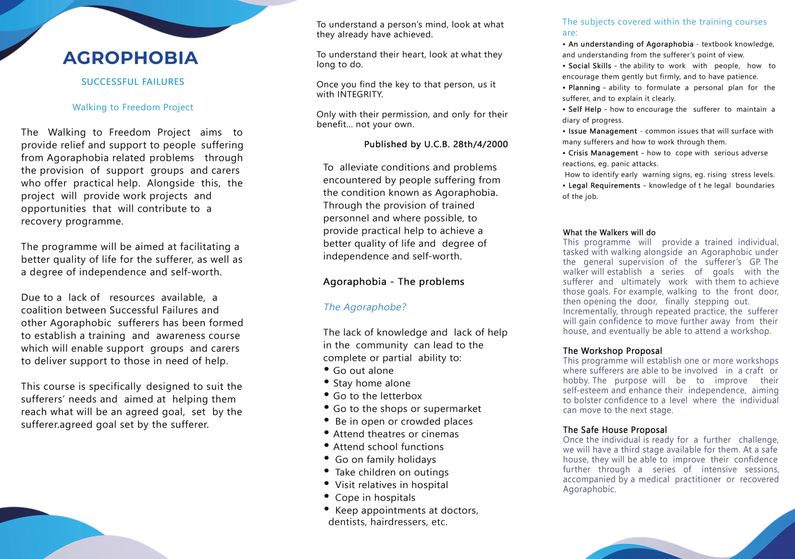
We will train your staff on how to handle people that are agoraphobic. Click to download our proposal for training Staff.
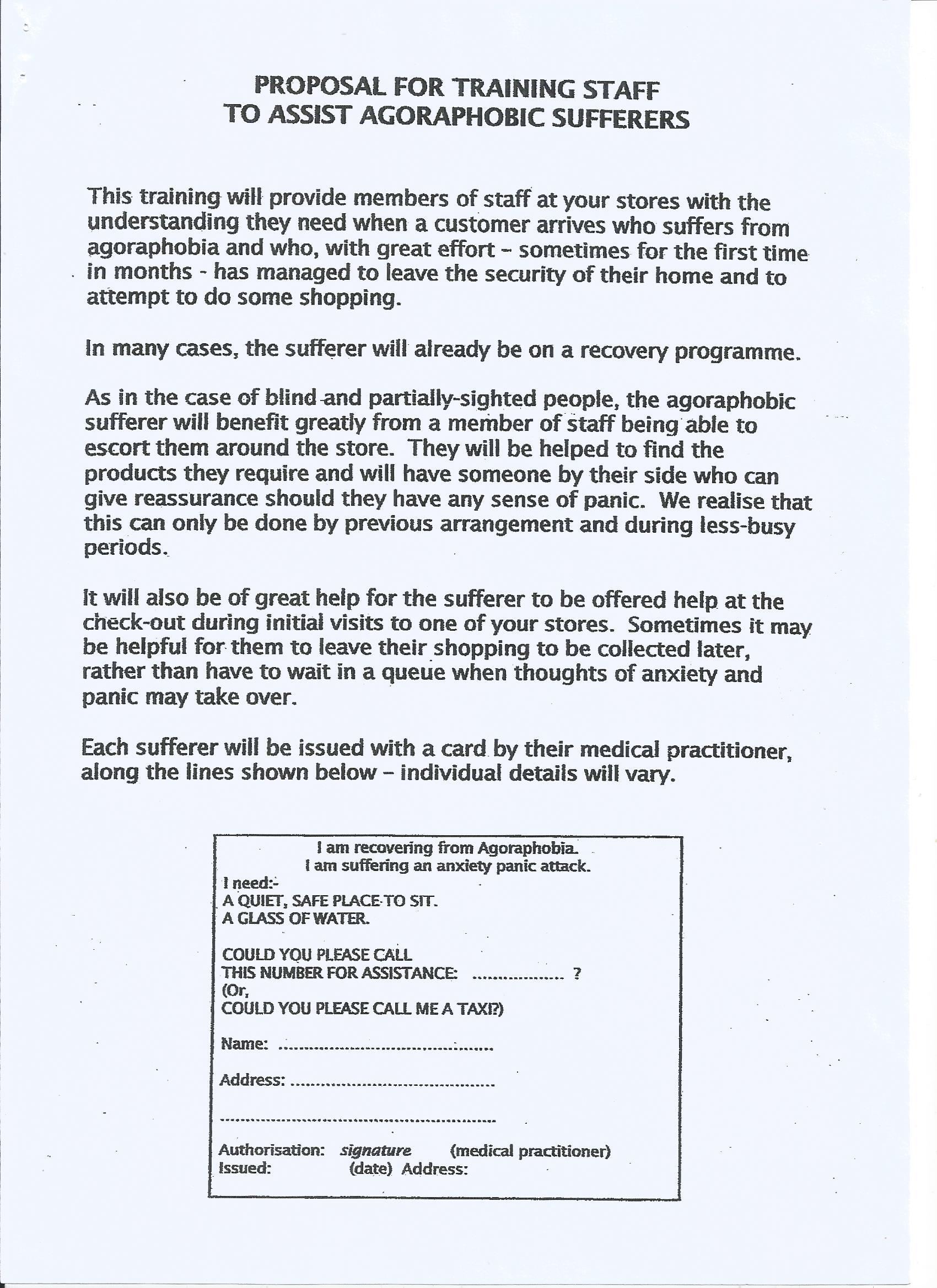
Walking to Freedom Project Objects to provide relief and help to people suffering from Agoraphobia related problems, through the provision of support groups and carers delivering the current kind of practical help. Also, provide work projects that will contribute to a recovery programme. The programme will be aimed at providing the means for sufferers to achieve a better quality of life and a degree of independence and self-worth.
Due to a lack of resources available, I and other sufferers have set about putting in place a training and awareness course that will provide the knowledge gathered from existing sufferers. This knowledge will enable support groups and carers to deliver help to the sufferer that has been designed to suit the sufferers’ needs. This help will be aimed at helping the sufferer reach what will be an agreed goal set by the sufferer.
To understand a person’s mind, look at what they already have achieved. To understand their heart, look at what they long to do. Once you find the key to that person, use it with INTEGRITY. Only with their permission, and only for their benefit… not your own. Published by U.C.B. 28th/4/2000
The subjects covered within the training courses possess:
- An understanding of Agoraphobia - textbook knowledge, and understanding from the sufferer’s point of view.
- Social Skills - the ability to work with people, how to encourage gently but firmly, and to have patience.
- Planning skills- ability to formulate a personal plan for the sufferer, and to explain it clearly.
- Self Help - how to encourage the sufferer to maintain a diary of progress.
- Issue management skills - common issues that will surface with many sufferers and how to work through them.
- Crisis management skills - how to cope with serious adverse reactions, e.g. panic attacks. How to identify early warning signs, e.g. rising stress levels.
- Legal responsibility - knowledge of the legal boundaries of the job. This programme will consist of a trained person walking with an Agoraphobic under the general supervision of the sufferer’s GP. The walker will establish a series of goals with the sufferer and then will work with them to achieve those goals, for example, for an hour a day, over three months. Through incremental steps and repeated practice, the sufferer will gain the confidence to move further away from their house, and eventually be able to attend a workshop.
The Workshop Proposal
This programme will establish one or more workshops where sufferers can be involved in a craft or hobby. The purpose will be to improve their self-esteem and enhance their independence, aiming to bolster confidence to a level where the individual can move on to the next stage.
The Safe House Proposal
Once the individual is ready for a further challenge, we will have a third stage available for them. At a safe house, they will be able to extend their confidence further in intensive sessions, accompanied by medical practitioners or recovered Agoraphobics. To alleviate conditions and problems encountered by people suffering from the condition known as Agoraphobia. Through the provision of trained personnel and where possible, to provide practical help to achieve a better quality of life and degrees of independence and self-worth.
The lack of knowledge and lack of help in the community can lead to the complete or partial inability to:
- Go out alone
- Stay in the house alone
- Go to the letterbox
- Go to the shops or supermarket
- Be in open or crowded places
- Attend theatres or cinemas
- Attend school functions
- Go on family holidays
- Take children on outings
- Visit relatives in hospital
- Cope in hospitals
- Keep appointments at doctors, dentists, hairdressers, etc.
Course Outline
The Training Course outline below is for Support Groups and has been developed by Agoraphobic sufferers and aims to educate and empower support networks in an Agoraphobic’s life – promoting freedom and independence, towards a life that is free from isolation.